↓
 

News Progress

More news about the people of Moultrie County than any other newspaper in the world

  • Home
  • News
    • News Briefs
    • Jail Report
    • Mo. Co. Most Wanted
    • Obituaries
  • Feature Stories
  • Sports
  • Editorials
  • Social
    • Video Archive
    • Poll Archive
  • Links
    • News Progress Staff
    • History of the News Progress
    • RR's Portfolio
  • Email Us
  • General News Submissions
  • Subscription
    • Members Area
    • Current Issue
    • Manage Your Profile
  • Login

Submit a news item, obituary, or legal notice to advertise@newsprogress.com

March 17, 2026 Election Results

Category Archives: Editorials

Post navigation

← Older posts
Newer posts →

Political Figures from Illinois: Recipients of the Nobel Prize for Peace, Leaders During Wartime

News Progress Posted on March 14, 2018 by webmasterMarch 14, 2018

Associated Press photo U.S. Sen. Everett Dirksen in 1968.

•March 14, 2018•

By Kerry Lester
The Daily Herald

The Gettysburg Address. Hull House. The nation’s first African American president — and first lady. All of these are due to Illinois’ bumper crop of political figures and politicians, who represent a diverse range of viewpoints and contributions throughout history.

Here, in alphabetical order, are some of the leaders who came from our state:

Jane Addams

A social worker and a leader in the women’s suffrage movement, Addams was the first American woman to receive the Nobel Peace Prize. She ran Hull House, a settlement house for poor immigrants in Chicago, and co-founded the American Civil Liberties Union. She also chaired a women’s conference for peace in the Netherlands in 1919 and worked unsuccessfully to get the United States to serve as a mediator between warring countries in World War I. She died in 1935 in Chicago. I-90 in Illinois is named after her. Read More

Posted in Editorials

Understanding Illinois: Could This be Mike Madigan’s Last Hurrah? A Half Century May be Enough

News Progress Posted on March 7, 2018 by webmasterMarch 7, 2018

•March 7, 2018•

By Jim Nowlan
NP Guest Columnist

My Springfield insider friends say I am loony to think 2018 will be Illinois House Speaker Mike Madigan’s last hurrah. Yet I think it will be. I array my arguments below; first a little history.

Democrat Mike Madigan has been representing the once-Irish Southwest Side of Chicago for half a century.

Madigan was elected a delegate to the Illinois Constitutional Convention in 1969 and then immediately moved to the state House. He has been there ever since, the last three decades as Speaker.

I served with Mike back in his early days, during my brief two terms in the House. Mike was very quiet as a young lawmaker (he still is), learning his craft in support of his patron, Chicago mayor Richard J. Daley, the Boss. Read More

Posted in Editorials

Abraham Lincoln Pivotal Figure In Securing Springfield As State Capital

News Progress Posted on March 7, 2018 by webmasterMarch 7, 2018

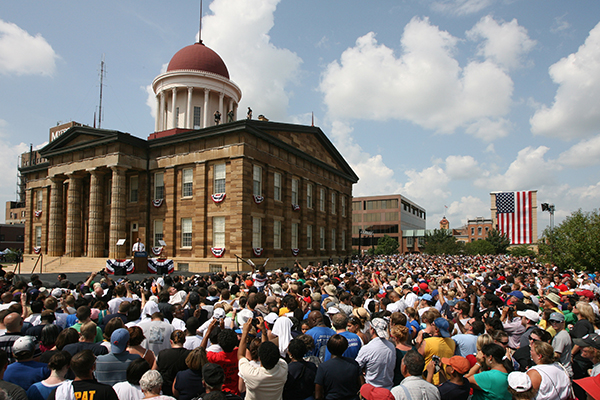
The Old State Capitol building in Springfield may no longer be used to conduct the people's business, but it is a popular place for events, re-enactments and political rallies. Barack Obama declared in 2007 he intended to seek the Democratic nomination for president during an announcement at the Old State Capitol. T.J. Salsman/The State Journal-Register

•March 7, 2018•

By Kate Schott
Of the State Journal-Register

When state lawmakers head to the Capitol to do the people’s business, they travel to Springfield. But that wasn’t always the case.

Springfield became the state’s third capital city in 1839. And the story of how Springfield became the capital is a tall tale … well, it’s a tale with an outcome scripted by nine tall men.

Illinois has been governed from three cities and six buildings (one that was rented and five that were owned by the state), as told in an article in the 1975-76 edition of the legislative Illinois Blue Book. Kaskaskia was the first state capital after Illinois was admitted to the union in 1818, with the 29 House members and 14 senators in the first General Assembly of Illinois working in a rented two-story brick building at a cost of $4 per day.

Yet by December 1820, the second General Assembly was meeting in a new building in a new capital city, Vandalia, which was a more central location within the state’s original 16 southern counties. Lawmakers agreed Vandalia would remain the capital city for at least the next 20 years. Read More

Posted in Editorials

Illinois Has Embraced its Role as the Land of Lincoln

News Progress Posted on February 28, 2018 by webmasterFebruary 28, 2018

•February 28, 2018•

By Kate Schott
The State Journal-Register

Abraham Lincoln may not have been born in Illinois but he clearly is among the state’s favorite sons.

Lincoln came into the world on Feb. 12, 1809, in Hodgenville, Kentucky, but eventually spent several decades living in Illinois, and departed for the presidency as a resident of Springfield. He was a shopkeeper, postmaster, lawyer, and state and federal legislator before being elected president in 1860.

He served as the nation’s 16th president from March 1861 until his assassination in April 1865. The bullet fired by John Wilkes Booth prematurely took one of the nation’s greatest presidents from its citizens, but could not diminish his accomplishments -- notably the abolishment of slavery -- that have defined his legacy.

Planting roots in Illinois Read More

Posted in Editorials

Understanding Illinois: The Unsung Volunteers who Shaped Illinois

News Progress Posted on February 28, 2018 by webmasterFebruary 28, 2018

•February 28, 2018•

By Jim Nowlan
NP Guest Columnist

On this 200th anniversary year of statehood for Illinois, I will, now and then, profile Illinoisans who played key roles in shaping our state, but whom most readers probably don’t know.

Edward Coles was a Virginia patrician with a strong sense of noblesse oblige. He served in the White House for six years as James Madison’s personal secretary and later led the first mission on a US warship into the Baltic Sea, where he successfully smoothed over a diplomatic problem with the Czar.

Yet Coles was drawn to Illinois. Before reaching our state in 1819, he freed his inherited slaves. In the Prairie State, Coles developed a big farm near Edwardsville.

Elected governor with one-third of the vote in 1822 in a multi-candidate race, Coles faced a pro-slavery legislature. Read More

Posted in Editorials

Keeley Gold Cure for Alcoholism was a Boon for the Business and Dwight

News Progress Posted on February 21, 2018 by webmasterFebruary 21, 2018

•February 21, 2018•

By Myke Feinman
Of The Paper (Dwight, Illinois)

The Keeley Cure initially had gold in it, but the real gold was in the number of satisfied alcohol or other drug-addicted customers who were cured and the social support system from the community of Dwight.

Lynn Neville brought the history of the Keeley Institute to life for those attending a recent meeting of Dwight Historical Society at the Prairie Creek Public Library in Dwight.

The location was appropriate because the building itself is the former clubhouse utilized by patients at the Keeley Institute, located adjacent to the Country Mansion restaurant, also a former Keeley building.

Dr. Leslie E. Keeley, the son of a country doctor, was born in 1832 in New York. He headed West as a young man, graduating from Rush Presbyterian Medical College in Chicago. In 1864, he enlisted and served in the Union Army during the Civil War.

“As an assistant field surgeon, he knew opiates were used as anesthesia, as well as alcohol, and the opiates, alcohol and tobacco were also often used in excess by the soldiers ... and they became addicted,” Neville said. Read More

Posted in Editorials

Understanding Illinois: Business Group Prescribes Bitter Medicine for State Budget

News Progress Posted on February 21, 2018 by webmasterFebruary 21, 2018

•February 21, 2018•

By Jim Nowlan
NP Guest Columnist

In its just released report, the Civic Federation of Chicago prescribes bitter medicine as the only way to cure the state’s fiscal woes. The remedies offered are probably more than many or most readers can stomach. And please don’t shoot this messenger for what follows.

I write this just before Gov. Bruce Rauner is to give his annual budget message. I will wager dollars to dimes he did not echo the Civic Federation.

Founded in 1894, the Civic Federation of Chicago board is a roll call of Chicagoland’s leading businessmen and women, not a wild-eyed liberal group.

The group’s staff of 12 analysts pore over the budgets of Chicago, Cook County and state governments. Their recommendations are respected but not always adopted. Gluttons for punishment may download the 60-page report by going to the group’s website.

First, the Civic Federation lays out a list of atrocious budget realities, a few of which are: Read More

Posted in Editorials

Chicago Defender Becomes National Voice for African Americans

News Progress Posted on February 14, 2018 by webmasterFebruary 14, 2018

•February 14, 2018•

By The Chicago Defender
IP Bicentennial Series

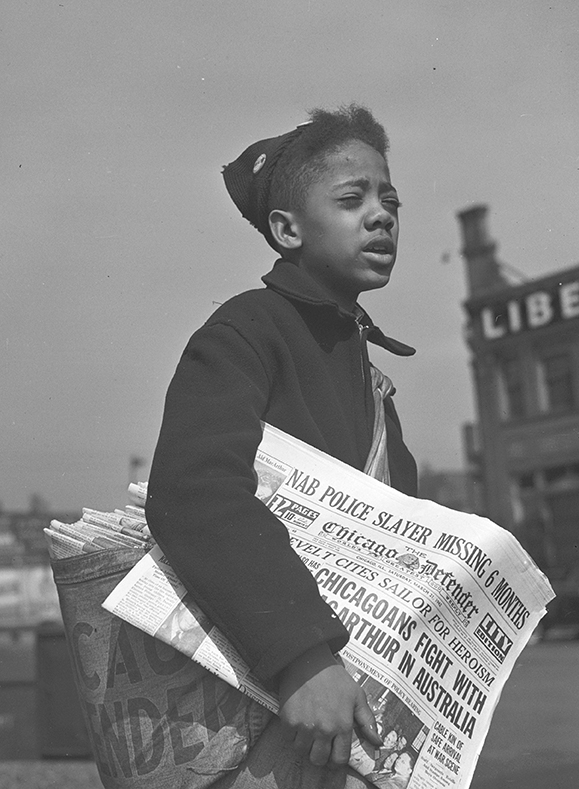
On May 5, 1905, Robert Sengstacke Abbott founded the Chicago Defender newspaper in a small kitchen in his landlord’s apartment, with an initial investment of 25 cents and a press run of 300 copies.

The Chicago Defender’s first issues were in the form of four-page, six-column handbills, filled with local news items gathered by Abbott and clippings from other newspapers. Five years later, the Chicago Defender began to attract a national audience.

By the start of World War I, the Chicago Defender was the nation’s most influential Black weekly newspaper, with more than two thirds of its readership base located outside of Chicago.

During World War I, the paper utilized its influence to wage a successful campaign in support of The Great Migration. It published blazing editorials, articles and cartoons lauding the benefits of the North, posted job listings and train schedules to facilitate relocation, and declared on May 15, 1917, as the date of the “Great Northern Drive.” The Chicago Defender’s support of The Great Migration encouraged Southern readers to migrate to the North in record numbers. Between 1916 and 1918, at least 110,000 people migrated to Chicago, nearly tripling the city’s Black population. Read More

Posted in Editorials

Understanding Illinois: Pro-Choice, Pro-Life, or Pro-Reduction

News Progress Posted on February 14, 2018 by webmasterFebruary 14, 2018

•February 14, 2018•

By Jim Nowlan
NP Guest Columnist

Abortion is the defining, underlying issue of the Illinois GOP gubernatorial primary. Not taxes, not the budget deficit, nor the pension burden, nor education nor infrastructure—matters the governor and legislature can do something about.

This column is not about pro-life or pro-choice arguments, but about whether the two sides could ever come together to work on efforts both sides might agree on—how to reduce the number of abortions. My friend Perry Klopfenstein of Gridley (north of Bloomington) thinks it is possible.

First, the governor’s race. Earlier this year Gov. Bruce Rauner signed a bill that provides taxpayer funding for abortions, after declaring on several occasions, even to the Catholic cardinal of Chicago, that he would veto the bill.

This action prompted outrage among pro-life conservative Christian groups in the state. And it was the catalyst for the GOP gubernatorial run of conservative state Rep. Jeanne Ives of Wheaton. Read More

Posted in Editorials

1,000 Years Ago, Illinois Had the Largest City in What Would Become the United States

News Progress Posted on February 7, 2018 by webmasterFebruary 7, 2018

•February 7, 2018•

By Susan Sarkauskas and Diane Dungey
Of the Daily Herald

Centuries ago Illinois was home to the largest and most influential city in what would become the United States, rivaling the size of European cities at the time.

As many as 20,000 people ­­— double that if surrounding communities are included — lived about 1,000 years ago in the elaborate planned city that now lies within the Cahokia Mounds State Historic Site.

Cahokia, east of St. Louis, includes woodhenges — large sun calendars that were built of red cedar posts — and at least 120 mounds and pyramids used to support important buildings and for burials.

Yet, Cahokia is only part of Illinois’ rich American Indian heritage. Read More

Posted in Editorials

Post navigation

← Older posts
Newer posts →


OV Golf Senior Night


News Progress


Okaw Valley’s Gabby Totten, a member of the CAM/OV Golf Team, celebrated senior night at the Moweaqua Golf course on September 25.


© 2024 - News Progress
Privacy Policy and Terms of Use

100 W. Monroe St., Sullivan, IL 61951 Phone: 217-728-7381 | Open: Hours Vary

↑