↓
 

News Progress

More news about the people of Moultrie County than any other newspaper in the world

  • Home
  • News
    • News Briefs
    • Jail Report
    • Mo. Co. Most Wanted
    • Obituaries
  • Feature Stories
  • Sports
  • Editorials
  • Social
    • Video Archive
    • Poll Archive
  • Links
    • News Progress Staff
    • History of the News Progress
    • RR's Portfolio
  • Email Us
  • General News Submissions
  • Subscription
    • Members Area
    • Current Issue
    • Manage Your Profile
  • Login

Submit a news item, obituary, or legal notice to advertise@newsprogress.com

March 17, 2026 Election Results

Category Archives: Editorials

Post navigation

← Older posts
Newer posts →

Illinois’ Long Romance With Trains Endures

News Progress Posted on September 26, 2018 by webmasterSeptember 26, 2018

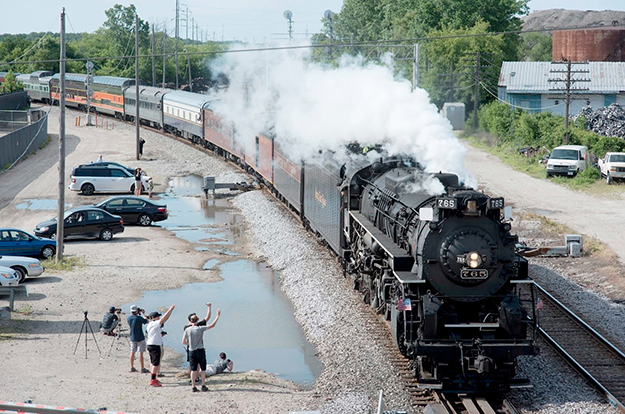
Photo Joe Lewnard/jlewnard@dailyherald.com
Railway fans greet a vintage Nickel Plate 765 or “Berkshire” steam locomotive traveling near Libertyville in 2016.

Railroads made Chicago, stealing commerce from steamboat hubs like St. Louis. But it’s a love-hate relationship in the suburbs and Chicago today.

•September 26, 2018•

By Marni Pyke
Of the Daily Herald

Trains brought Abraham Lincoln’s body home to Illinois, transported southern blacks escaping Jim Crow laws to Chicago, and now carry a labor force of thousands between the suburbs and downtown Chicago daily.
Freight, passenger and commuter trains pass through the Chicago area at the rate of 1,300 a day, Illinois Department of Transportation says, and rail lines fan out in every direction.
“People in Illinois are as intimately tied to railroading as anywhere in the country,” DePaul University transportation professor Joseph Schwieterman said. “Millions live close to busy rail lines, use commuter or intercity passenger trains, or cross busy sets of tracks every day, giving them a strong psychological connection to railroads.”
But being the rail hub of the nation also has its downside: Meager funding for commuter rail, crossing delays, and freight gridlock are among the challenges facing the state in the 21st century. Read More

Posted in Editorials

The Chicago Bears NFL Franchise Began in Decatur as the Staleys

News Progress Posted on September 19, 2018 by webmasterSeptember 19, 2018

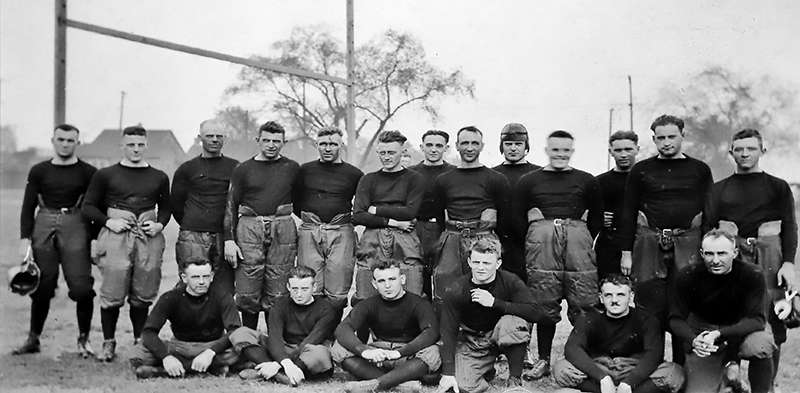
Photo by Jim Bowling, Herald & Review
A team photo of the original Decatur Staleys.

•September 19, 2018•

By Justin Conn
Of the Decatur Herald & Review

A.E. “Gene” Staley’s successful corn manufacturing company in Decatur was already producing starch, glucose, sugar and syrup in 1919 when it added professional football to the assembly line.
Staley, owner of the Staley Manufacturing Co., would eventually make Decatur the “Soybean Capital of the World.” He was behind the creation of Lake Decatur, the Staley viaduct and the Staley Building (now the Tate and Lyle Building).
But Staley’s legacy will forever be linked with the NFL’s Chicago Bears, originally the Decatur Staleys — a football team that grew from Staley’s desire to dominate an industrial football league and expand his brand.
With no professional football league at that time and many former college football players working factory jobs, industrial leagues rose in popularity in the early 1900s — particularly in the college-football-crazy Midwest.
Staley, wanting to offer athletics as an outlet for his employees, decided in 1919 to form a team of his own. The first team was made up of the existing pool of Staley employees, though about half the squad had played in college. The team practiced and played at Staley Field — built and also used as a baseball facility. Read More

Posted in Editorials

Growing Up In Sullivan: Western Union Telegrams – The Source of a Career

News Progress Posted on September 19, 2018 by webmasterSeptember 19, 2018

By Jerry L. Ginther
NP Guest Columnist

I’ve been hard pressed to find anyone who has ever received an old fashioned Western Union Telegram. I have to admit that I have not seen one in many years, and I do not recall ever receiving one.
However, I do recall my grandparents receiving a couple of telegrams concerning the deaths of close relatives who lived in other states. At the time there was no telephone in their home, and telegrams were faster than the U.S. Postal Service. These messages were hand delivered by the station agent from the C&EI Railroad depot located on the west side of Sullivan, Ill.
I was a young boy, probably in the first or second grade, and happened to be present on one such occasion. The agent, knowing the contents of the telegram, expressed condolences and departed. He did not wait for a tip nor charge anything for the delivery.
Interestingly, later in life, that very same agent would become a good friend, mentor and teacher. When I was 14 years old and out for a bicycle ride one afternoon, I happened to stop by the depot. Having learned something about the inventor of the telegraph in school, Samuel F. B. Morse, I was curious to see this method of communication in operation. Also, in scouts we had learned a little bit about the Morse code. Read More

Posted in Editorials

Ft. Armstrong, Rock Island Arsenal Have Defended Nation Since 1816

News Progress Posted on September 12, 2018 by webmasterSeptember 12, 2018

•September 12, 2018•

By George Eaton

In summer 1814, skirmishes between the U.S. and British-backed warriors under the leadership of Black Hawk flared up and down river from Rock Island.
Since 1803 the U.S. had owned both banks of the Mississippi River. Lt. Zebulon Pike had reached the Rock Island in 1805 and immediately recognized its strategic and tactical importance. The Rock Island Rapids raced for 12 miles upriver. From Rock Island, the Army could control the entire Upper Mississippi River Valley by controlling the rapids.
Locally, the Sauk and Meskwaki, led by Black Hawk, opposed a disputed 1804 treaty that transferred over 50 million acres of land to the U.S. An Army post on the island could also keep an eye on Black Hawk and his followers.
The battles of 1814 confirmed to the Army that it needed a presence on Rock Island. In May 1816, Fort Armstrong was built on the downriver end of the island. The small Army contingent there was tasked to control the Upper Mississippi River Valley by monitoring the Rock Island Rapids; maintaining observation of assumed anti-American Sauk Indians in the area; maintaining peaceful relations between the local Native American tribes; and, later, providing security as settlers moved into the area. Read More

Posted in Editorials

Understanding Illinois: Where Have All The Teachers Gone?

News Progress Posted on September 12, 2018 by webmasterSeptember 12, 2018

•September 12, 2018•

By Jim Nowlan
NP Guest Columnist

The agriculture teacher at my local high school recently up and left, days before the school year started, heading for greener pastures in the private sector, leaving the school district in the lurch. He’s not alone.
School leaders in low-paying rural districts as well as in the good-paying but challenging Chicago public schools are scrambling to fill teacher vacancies. Many will do with marginal staff, substitutes, online and distance learning (over internet) course offerings. Not fair to the students.
When I was a boy post-WWII, talented women were steered into teaching, because they had few other career choices than nursing and secretarial work. Not today. They go to law and medical school, where they now outnumber men, and are beseeched to go into computers and the sciences, where their numbers are still low.
Today, teachers and parents often steer youngsters away from teaching. In this space a couple of years ago, I reported on responses, from a group of excellent teachers I know, to the question: Would you recommend teaching as a career?
Most said No, even though they mostly found their teaching careers rewarding. The lament I heard most often was that of “the pressure to teach to the standardized tests.” It takes the zest out of teaching, the teachers said. Read More

Posted in Editorials

Understanding Illinois: Beware Biting Hand That Feeds Downstate

News Progress Posted on September 5, 2018 by webmasterSeptember 5, 2018

•September 5, 2018•

By Jim Nowlan
NP Guest Columnist

Three Downstate (outside metro-Chicagoland) legislators recently introduced a resolution to separate Chicago from the rest of Illinois.
Based on a recent analysis of the incidence and reflection of state revenue and spending, these lawmakers should be wary of biting the hand that feeds Downstate.
Resentment of Chicago by Downstaters goes back at least to 1870. For a graduate paper written years ago, for instance, I quoted from the diary of a man from my hometown of Toulon (Stark County), who in 1870 visited the House gallery in the old state capitol. He wrote that he was regaled by a debate on the House floor over whether to cede Chicago to Wisconsin or Indiana.
Yet, according to a report issued in July by the Paul Simon Public Policy Institute at SIU, the 96 Downstate counties (outside the 6 counties that make up Chicagoland) receive dramatically more in spending from the state than they send to Springfield in taxes.
The big losers are the suburban counties that surround Cook (Chicago). The Simon Institute analysis shows the suburban counties receive back only 50 cents for every dollar they send to Springfield in taxes.
In sharp contrast, the 19 counties in deep southern Illinois, where resentment of Chicago seems strongest, receive almost $3 for every dollar folks there send in. Read More

Posted in Editorials

Mother Jones: “I’m Not a Humanitarian, I’m a Hell Raiser!”

News Progress Posted on September 5, 2018 by webmasterSeptember 5, 2018

Photo furnished
Pictured is Mother Jones.

•September 5, 2018•

By Phil Luciano
Of the Journal Star, Peoria

She lost her own family, so she adopted a new one, a huge one, lifting up the cause of labor while rising to become one of the most famous women in American history.
In the process, Mother Jones became perhaps the greatest labor force in the history of Illinois, a state no stranger to workers’ movements. Barely over five feet tall, the dynamo who was Mary Harris Jones didn’t start speaking and organizing until her mid-50s, a peripatetic rabble-rouser nationally from the 1890s to 1920s – yet always with a heart for Illinois.
“Illinois ranks as a union birthplace, and Mother Jones was a midwife in that process,” says Mike Matejka, vice president of the Illinois Labor History Society. “She formed deep friendships with Illinois workers, from miners to union leaders, and continually returned to Illinois as a home base, roaming the state to mobilize and awaken the working class.”
In her heyday, no labor leader inflamed passion like Mother Jones. Muckraker Upton Sinclair, whose “The Jungle” excoriated the Chicago meatpacking industry, summed up Jones thusly: “All over the country she had roamed, and wherever she went, the flame of protest had leaped up in the hearts of men; her story was a veritable Odyssey of revolt.”
Yet she assumed that mantle only because of circumstance, then guile. Read More

Posted in Editorials

Black Hawk, Proud Leader of the Sac and Fox Tribe of the Rock River Valley

News Progress Posted on August 29, 2018 by webmasterAugust 29, 2018

Black Hawk statue is seen from the west side of the Rock River on Wednesday, July 16, 2014, at Lowden State Park in Oregon. MAX GERSH/RRSTAR.COM

•August 29, 2018•

By Chuck Sweeny
Of the Rockford Register Star

First, let’s get his name straight. It was Ma-ka-tai-me-she-kia-kiak. In English, he was Black Hawk, war chief of the Sac and Fox tribe who lived most of his life in the Rock River Valley in northern Illinois.
Black Hawk was born in 1767 in Saukenuk, a Sac and Fox village on the Rock River in northwestern Illinois. He built his reputation as a war fighter leading his tribe in skirmishes against the Osage tribe.
In the late 1700s and early 1800s, a new enemy appeared — Americans, relentlessly moving west from the Eastern states, claiming the land for themselves as they went, building homes and villages and fencing off the fields.
The U.S. Army and state militias accompanied the settlers and protected them against the people who had been there for thousands of years. Treaty after treaty was made between the native people and the U.S. government, and they were regularly broken.
One of those documents was the Treaty of 1804, signed in St. Louis by representatives of the Sac and Fox tribe and U.S. officials. Black Hawk, who had not been at the signing, thought the treaty merely ceded some of the tribe’s ancestral hunting grounds to the American settlers. Read More

Posted in Editorials

Understanding Illinois: Neighboring State Rejects Illinois’ Children

News Progress Posted on August 29, 2018 by webmasterAugust 29, 2018

•August 29, 2018•

By Jim Nowlan
NP Guest Columnist

Apparently unable to care for our own youth, the Illinois Department of Children and Family Services (DCFS) recently tried to place some of its wards (wards of the state, meaning you and me) with Indiana state social service agencies. But the Hoosiers rejected our pleas: “Sorry, Illinois, but you’re a bad payment risk.”
ProPublica, a non-profit investigative news organization, reported recently that DCFS wards were languishing in Illinois mental health facilities much longer than necessary because DCFS had no place for them to be placed. Thus, the efforts to place wards in nearby Indiana facilities. A DCFS staffer noted that parents of institutionalized children will often refuse to take their children back, which creates an immediate need for placement.
Throughout my half-century of observing Illinois, DCFS has continually been on the front pages—for such as allegedly failing to prevent a child’s death by neglect, or for failing to take another child out of a home where an abusive, possibly violent boyfriend lurks in the background, just out of sight. Read More

Posted in Editorials

Understanding Illinois: Offenders Trying To Break Into This Prison

News Progress Posted on August 22, 2018 by webmasterAugust 22, 2018

•August 22, 2018•

By Jim Nowlan
NP Guest Columnist

I just came back to my home office after attending the first-ever graduation of Illinois prison inmates who earned—outside their razor-wire fence “home”—their skilled welding program certificates at a Black Hawk College career training center in Kewanee.
Less than a year ago, I wrote in this space about a new, unique prison in Illinois called the Kewanee Life Skills Re-entry Center. The idea here is to provide career and behavioral training to medium and high-risk offenders who are within one to four years of release.
Black Hawk College has a welding center a few blocks from the Life Skills Center. Why not have inmates take their training “outside,” at the center?
“No way, can’t be done,” the bureaucrats said, of course. State senator Chuck Weaver (R-Peoria) and nearby attorney and workforce development specialist Mike Massie said, “Phooey on you,” and the barriers to such were pushed aside.
The objective is, of course, to reduce the Illinois recidivism rate, one of the highest in the nation. Recidivism refers to those released from prison who are returned to incarceration within three years of release. In Illinois the rate has been about half, and for African-Americans it has been three in five! Read More

Posted in Editorials

Post navigation

← Older posts
Newer posts →


OV Golf Senior Night


News Progress


Okaw Valley’s Gabby Totten, a member of the CAM/OV Golf Team, celebrated senior night at the Moweaqua Golf course on September 25.


© 2024 - News Progress
Privacy Policy and Terms of Use

100 W. Monroe St., Sullivan, IL 61951 Phone: 217-728-7381 | Open: Hours Vary

↑