↓
 

News Progress

More news about the people of Moultrie County than any other newspaper in the world

  • Home
  • News
    • News Briefs
    • Jail Report
    • Mo. Co. Most Wanted
    • Obituaries
  • Feature Stories
  • Sports
  • Editorials
  • Social
    • Video Archive
    • Poll Archive
  • Links
    • News Progress Staff
    • History of the News Progress
    • RR's Portfolio
  • Email Us
  • General News Submissions
  • Subscription
    • Members Area
    • Current Issue
    • Manage Your Profile
  • Login

Submit a news item, obituary, or legal notice to advertise@newsprogress.com

March 17, 2026 Election Results

Post navigation

← Older posts
Newer posts →

Saukenuk was Once Home to Black Hawk and More Than 6,000 Sauk

News Progress Posted on October 24, 2018 by webmasterOctober 24, 2018

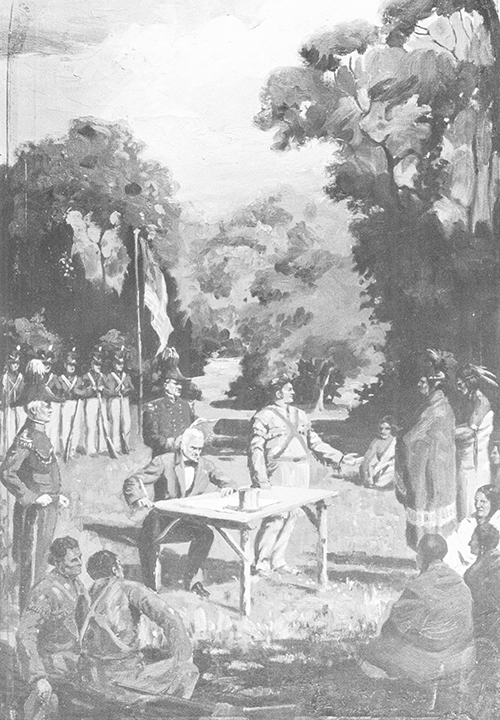
Photo courtesy of Rock Island Arsenal Museum
Antoine LeClaire, an early area settler, Illinois Gov. John Reynolds and Gen. Winfield Scott, at the table, are depicted in this mural of the signing of Black Hawk Purchase Treaty of 1832. Agreed to in the wake of the Black Hawk War, the sale conveyed Sauk lands in Iowa to the United States.

•October 24, 2018•

By Roger Ruthhart
IP Guest Columnist

Saukenuk was well-known as one of the largest Native American villages in North America, but one of its residents, the warrior Black Hawk, was even better known.
Although born in Saukenuk, which was located where Rock Island stands today, his father Pyesa and mother Summer Rain and other relatives could trace their ancestry back thousands of years. According to their oral traditions, both the Sauk and Meskwaki tribes were living in Canada 12,000 years ago at the time of the last glacial retreat. Many centuries later they were displaced from their Canadian home by the Iroquois.
The Sauk and Meskwaki migrated through New England and New York to the area near Niagara Falls. By 1640, the Meskwaki had settled at the west end of Lake Erie, near present-day Detroit, and the Sauk near Saginaw Bay in Michigan.
In 1701, the decades-long war began between the French and the Meskwaki, which almost led to the tribe’s extinction. Weakened, they joined the Sauk and together they migrated to the Mississippi River, where for nearly 100 years the tribes lived in their own villages and farmed, hunted and traded. Read More

Posted in Editorials

Bloomington’s David Davis Mansion Home to Abraham Lincoln’s Strongest Advocate

News Progress Posted on October 17, 2018 by webmasterOctober 17, 2018

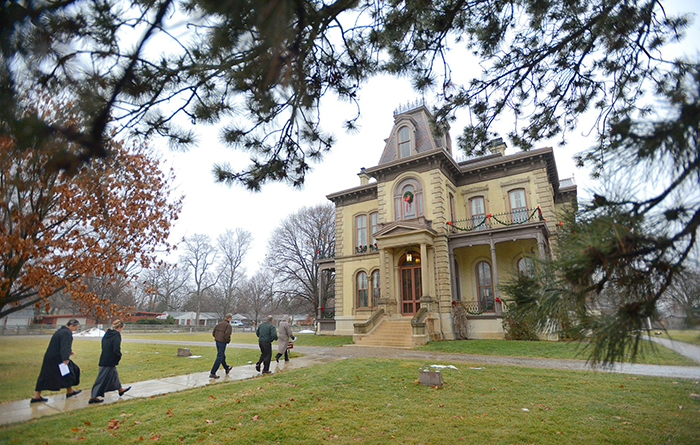
PANTAGRAPH FILE
The David Davis State Historic Site at 1000 E. Monroe Drive, Bloomington.

•October 17, 2018•

By Julia Evelsizer
Of the (Bloomington) Pantagraph

Grand manors make up the skylines of many Illinois communities, but the history encapsulated at the David Davis Mansion in Bloomington holds it above the rest.
Built in 1872 on Bloomington’s then east side, the mansion was home to Judge David Davis and his wife, Sarah.
Davis served as judge of the state’s Eighth Judicial Circuit Court where he met and befriended an Illinois attorney by the name of Abraham Lincoln.
“Davis and Lincoln rode the entire circuit together,” said Jeff Saulsbery, site manager for the mansion. “Davis had to ride the circuit because he was a judge, but Lincoln only did because he was driven to make something of himself.”
Saulsbery said the duo spent plenty of time together, which led to Davis acting as “one of the biggest political operatives” in Lincoln becoming president.
“What Lincoln did for the Circuit and what the Circuit did for him is a large part of Illinois history. His time in Central Illinois is what led to him becoming the 16th president of the U.S. and saving the Union,” said Guy Fraker, retired Bloomington attorney and Lincoln scholar. Read More

Posted in Editorials

Understanding Illinois: Illinois Higher Education—from Best to Bleakest

News Progress Posted on October 17, 2018 by webmasterOctober 17, 2018

•October 17, 2018•

By Jim Nowlan
NP Guest Columnist

In 2000, a national group that knows about such things declared Illinois to have the best higher education offerings among the states for quality and affordability. Today, in contrast, nearly half all Illinois high school grads headed to college flee to institutions out of state. This can be turned around, but not without a renewed collaboration among state leadership on affordability, focus and understanding of the new realities.
Some background. Though not everyone needs a bachelor’s degree, every youngster who can benefit needs post-high school training and education. To meet these needs for three-quarters of a million of our citizens, Illinois offers four “layers” of higher education.
There are graduate research universities (think University of Illinois) and teaching universities (such as Illinois State University). And private colleges (e.g., Northwestern and Knox, which in total educate more four-year college students than the publics), and community colleges, which blanket the state. There are also for-profit colleges, which range from good to rip-offs.
There was dramatic growth and lavish spending on higher education and student financial aid post-World War II up to the 1980s, when student numbers boomed and the state had some money. Read More

Posted in Editorials

Despite Headquarters Move, Peoria Still Home to 12,000 Caterpillar Workers

News Progress Posted on October 10, 2018 by webmasterOctober 10, 2018

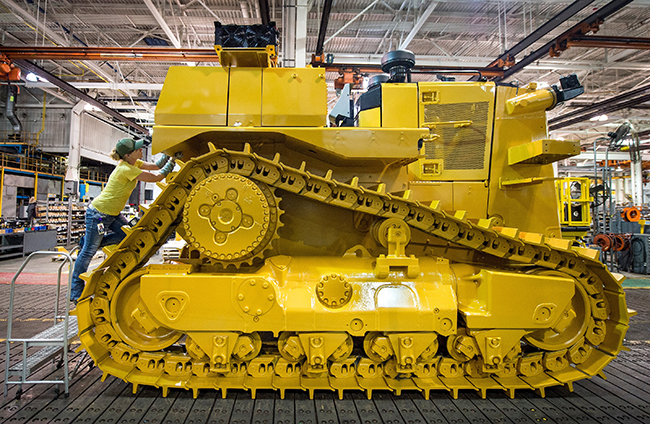
FRED ZWICKY/JOURNAL STAR
East Peoria’s Building SS is the manufacturing home of Caterpillar Inc’s D10, a trendsetting track-type dozer that is one of Caterpillar’s largest dozers in the company lineup. The company celebrated the 40th anniversary of the D10 in 2017. The D10 represented a significant advance in the design of tracks using an elevated sprocket.

•October 10, 2018•

By Steve Tarter
Of the Journal Star

Peoria wasn’t always a company town. It was a distillery town, a farm implement town and a river town before the Caterpillar Tractor Co. set up shop.
A bond developed between company and town that became a mutually-beneficial relationship.
Caterpillar rose to international prominence on the strength of rugged, reliable earthmoving machines while the Peoria area gained jobs — not only in bustling factories but at the headquarters of a Fortune 100 company, a rare distinction for a city of a population of 100,000.
But in 2017, that symbiotic relationship underwent a dramatic change. Caterpillar announced two things that reverberated across central Illinois: one, the company ditched plans for an expansive office project in Downtown Peoria that Caterpillar had promised with great fanfare just two years earlier, and, two, the corporate headquarters would move to the Chicago area. Read More

Posted in Editorials

Understanding Illinois: Take a Look at Giving Power Back to the People

News Progress Posted on October 10, 2018 by webmasterOctober 10, 2018

•October 10, 2018•

By Jim Nowlan
NP Guest Columnist

Illinois Democratic House Speaker Mike Madigan is not the evil Darth Vader trumpeted by opponents’ ads—but he has shut down democracy in Illinois, and must go.
Mike Madigan is simply an old-fashioned Chicago pol who has had half a century in office to hone his skills and thus accrue unprecedented power.
In the Illinois legislature, absolutely no bill—not one—introduced by representatives of the people will ever be heard and voted upon without the express approval of Mike Madigan. Every bill, indeed every amendment to every bill, must first be approved by the small Madigan-controlled House Rules Committee.
Even if a back-bench lawmaker wanted to overrule the Rules Committee so as to afford a bill a hearing, such is impossible, as it takes unanimous consent(!) to break a bill loose from the Rules Committee.
Democracies also offer opportunities for voter participation through referendums on issues of major importance, such as on wildly popular matters such as term limits and independent redistricting of legislative boundaries.
Yet Madigan has blocked repeated efforts to give the people a vote on these issues. Read More

Posted in Editorials

Understanding Illinois: Transportation Infrastructure: Our Neglected Crown Jewel

News Progress Posted on October 3, 2018 by webmasterOctober 3, 2018

•October 3, 2018•

By Jim Nowlan
NP Guest Columnist

Transportation infrastructure is our crown jewel, sparkling atop the lid on Illinois’ economic development toolkit. Neglect the jewel, and it might just slip off. And we are neglecting it.
Illinois has more miles—2,200—of interstate highways than all states but Texas and California. Just look at a highway map. The density of interstates crisscrossing Illinois stands out, in stark contrast to the road systems of our neighbors.
The interstates and 12,000 miles of federal and state two-lane highways in our state make it efficient for you and me to get around. More important, the ribbons of concrete move the goods we produce to a big swath of the nation, in just a day.
Add the following: The nation’s seven major railroads all flow into and out of metro-Chicago, and several go into the metro-St. Louis region; East and West Coast railroads come together in these cities. The president of the Union Pacific Railroad recently observed that 25 percent of all rail cargo in the nation originates, terminates and passes through Chicago.
A recent study by MIT found O’Hare Airport to have the best domestic as well as international connections of any airport in the nation! Read More

Posted in Editorials

Lincoln Turns Tide in Debates Against Douglas in Galesburg

News Progress Posted on October 3, 2018 by webmasterOctober 3, 2018

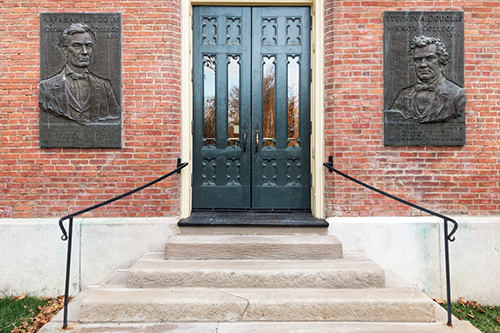
Credit: Steve Davis/The Register-Mail
Tablets of Abraham Lincoln and Stephen Douglas adorn the east entrance of Old Main on the Knox College campus in Galesburg. The tablets were hung during a celebration honoring the 100th anniversary of the Oct. 7, 1858, debate in Galesburg.

•October 3, 2018•

By Owen W. Muelder
For the Register-Mail of Galesburg

The Lincoln-Douglas Debates are among the most important events in the United State’s history.
The seven debates were conducted throughout Illinois in the summer and fall of 1858. Not only significant in their own time, the debates have since been recognized as an ultimate example of our political process - which has continued throughout the centuries as most office seekers nationwide debate each other every campaign season.
Stephen A. Douglas and Abraham Lincoln were respectively the Democratic and Republican party candidates for the U.S. Senate. The primary question these men discussed was whether slavery should be extended into the nation’s territories.
Lincoln was not an abolitionist, but he loathed slavery and looked forward to a time when it would disappear. He also maintained that it should be forbidden from being established in new states that desired to join the Union. Douglas defended the concept of “Popular Sovereignty,” whereby the people who resided in western territories should have the right to decide if slavery would be allowed.
The slavery question was so important then that no other political issue was raised by either candidate during the debates.
Public oratory was popular in the 19th century; both candidates often used harsh language and outspoken mud-slinging to characterize each other. People attending these contests also shouted out derogatory comments and catcalls toward both men. Spectators came from every part of Illinois to hear the speakers and newspapers throughout the country published detailed accounts. Read More

Posted in Editorials

Understanding Illinois: What the Next Governor and Legislature Must Do…

News Progress Posted on September 26, 2018 by webmasterSeptember 26, 2018

First, enact balanced budgets and a predictable fiscal system

•September 26, 2018•

By Jim Nowlan
NP Guest Columnist

This is the first of seven weekly columns that offer a blueprint for fixing Illinois, the title of the writer’s 2014 book (University of Illinois Press). Nowlan is a former Illinois legislator, agency director, senior aide to three unindicted governors, campaign manager for U.S. Senate and presidential candidates, and professor of government at several universities in Illinois as well as China.
The first order of business in transforming Illinois from a laggard to a leader, once again, among the American states is to enact balanced budgets and create a stable, transparent, predictable fiscal system, something the state has not accomplished even once in the past two decades. Only then will business leaders, entrepreneurs and creators be confident they can locate, build and expand in our state.
The numbers tell the sad story of our fiscal disarray. The 20 17 Comprehensive Annual Financial Report of the Office of the Illinois Comptroller shows that the net assets of the State of Illinois declined from a negative $6 billion in 2002 to minus $141 billion in 2017. [This number will plummet even further next year, when new accounting rules require Illinois to report its unfunded future employee health care costs.] Read More

Posted in Editorials

Illinois’ Long Romance With Trains Endures

News Progress Posted on September 26, 2018 by webmasterSeptember 26, 2018

Photo Joe Lewnard/jlewnard@dailyherald.com
Railway fans greet a vintage Nickel Plate 765 or “Berkshire” steam locomotive traveling near Libertyville in 2016.

Railroads made Chicago, stealing commerce from steamboat hubs like St. Louis. But it’s a love-hate relationship in the suburbs and Chicago today.

•September 26, 2018•

By Marni Pyke
Of the Daily Herald

Trains brought Abraham Lincoln’s body home to Illinois, transported southern blacks escaping Jim Crow laws to Chicago, and now carry a labor force of thousands between the suburbs and downtown Chicago daily.
Freight, passenger and commuter trains pass through the Chicago area at the rate of 1,300 a day, Illinois Department of Transportation says, and rail lines fan out in every direction.
“People in Illinois are as intimately tied to railroading as anywhere in the country,” DePaul University transportation professor Joseph Schwieterman said. “Millions live close to busy rail lines, use commuter or intercity passenger trains, or cross busy sets of tracks every day, giving them a strong psychological connection to railroads.”
But being the rail hub of the nation also has its downside: Meager funding for commuter rail, crossing delays, and freight gridlock are among the challenges facing the state in the 21st century. Read More

Posted in Editorials

The Chicago Bears NFL Franchise Began in Decatur as the Staleys

News Progress Posted on September 19, 2018 by webmasterSeptember 19, 2018

Photo by Jim Bowling, Herald & Review
A team photo of the original Decatur Staleys.

•September 19, 2018•

By Justin Conn
Of the Decatur Herald & Review

A.E. “Gene” Staley’s successful corn manufacturing company in Decatur was already producing starch, glucose, sugar and syrup in 1919 when it added professional football to the assembly line.
Staley, owner of the Staley Manufacturing Co., would eventually make Decatur the “Soybean Capital of the World.” He was behind the creation of Lake Decatur, the Staley viaduct and the Staley Building (now the Tate and Lyle Building).
But Staley’s legacy will forever be linked with the NFL’s Chicago Bears, originally the Decatur Staleys — a football team that grew from Staley’s desire to dominate an industrial football league and expand his brand.
With no professional football league at that time and many former college football players working factory jobs, industrial leagues rose in popularity in the early 1900s — particularly in the college-football-crazy Midwest.
Staley, wanting to offer athletics as an outlet for his employees, decided in 1919 to form a team of his own. The first team was made up of the existing pool of Staley employees, though about half the squad had played in college. The team practiced and played at Staley Field — built and also used as a baseball facility. Read More

Posted in Editorials

Post navigation

← Older posts
Newer posts →


Hot and ready


News Progress


Sullivan Boy Scout Troop # 39 was at the ready with delicious food in Kirby’s parking lot for famished deal-seekers on Friday, June 5th, during Sullivan’s annual Townwide Rummage Sale. On the menu were brats, steak sandwiches, pork chops, chips, sides, and cool beverages.


© 2024 - News Progress
Privacy Policy and Terms of Use

100 W. Monroe St., Sullivan, IL 61951 Phone: 217-728-7381 | Open: Hours Vary

↑