↓
 

News Progress

More news about the people of Moultrie County than any other newspaper in the world

  • Home
  • News
    • News Briefs
    • Jail Report
    • Mo. Co. Most Wanted
    • Obituaries
  • Feature Stories
  • Sports
  • Editorials
  • Social
    • Video Archive
    • Poll Archive
  • Links
    • News Progress Staff
    • History of the News Progress
    • RR's Portfolio
  • Email Us
  • General News Submissions
  • Subscription
    • Members Area
    • Current Issue
    • Manage Your Profile
  • Login

Submit a news item, obituary, or legal notice to advertise@newsprogress.com

Post navigation

← Older posts
Newer posts →

Understanding Illinois: We’re at War, and We’re Losing it Dollar by Dollar, Day by Day

News Progress Posted on November 21, 2018 by webmasterNovember 21, 2018

•November 21, 2018•

By Jim Nowlan
NP Guest Columnist

For millennia, war was how you did economic development. Today, economic dominance is how you do war, and we’re losing.
I read recently that some school districts across our country are going to four-day weeks, “to save money,” and maybe to provide families more flexibility.
The article brought to mind the first of my several six-week teaching gigs at Fudan University in Shanghai, each capped by invited lectures for me to give at universities all across China. This sure doesn’t make me an expert on China, yet allowed me some observations.
The day after I first arrived in Shanghai, now 15 years ago, I took a stretch-the-legs stroll from my “foreign expert guest quarters,” located on a leafy side street.
It was early Saturday morning, and I was surprised to see gaggles of cute, early grade school-age kids in neat uniforms, gathering outside what was obviously a school building.
Later I asked my host professor about this. “Oh, of course, our children all attend school every Saturday morning, until noon.”
Indeed, Chinese children not only attend school about 210 days each year (versus our 174 days), but for an hour longer each weekday than in the U.S. Read More
Posted in Editorials

Understanding Illinois: A Chance for Responsible Government Ahead

News Progress Posted on November 14, 2018 by webmasterNovember 14, 2018

•November 14, 2018•

By Jim Nowlan
NP Guest Columnist

As a result of the election Tuesday, Democrats are totally—I mean totally—in charge of Illinois government. Governor-elect J. B. Pritzker won a resounding victory and his party achieved more than 3/5ths majorities in both the House and Senate. And the Illinois Supreme Court continues to have a Democratic majority, as has been the case continuously since 1962.
This offers an unusual opportunity in Illinois for voters to place credit or blame, with some clarity, over the coming four years with one political party.
For most of the past half century, Illinois government has been divided, with Republicans often holding the governorship and Dems one or both chambers of the legislature. Even when Democrats controlled both the executive and legislative branches under Blagojevich and Quinn (2002-2014), these governors were often at odds with their legislative leaders.
In contrast, under parliamentary governments (think Canada and the United Kingdom), government is unified. Those nations do not have separate executives and legislatures; the chief executive (prime minister) is selected from within the party that controls the legislative branch (parliament).
So, it is easier for voters to assess blame or credit in parliamentary systems, as it will be in Illinois over the coming term of governor-elect Pritzker. Read More

Posted in Editorials

Barack Obama’s Political Career in Illinois Helped Shape His Presidency

News Progress Posted on November 14, 2018 by webmasterNovember 14, 2018

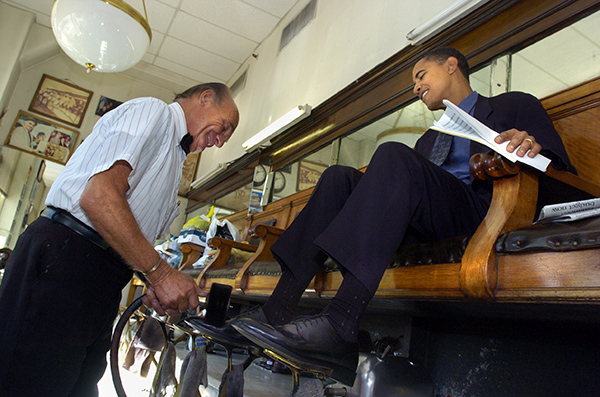
RON JOHNSON/Journal Star Democratic candidate Barack Obama gets a high gloss shine on his shoes from Peoria icon and shoe shiner George Manias who has buffed the shoes of presidents, congressmen and Supreme Court justices alike.
Senate race between Barack Obama and Alan Keyes. Heartland picture story on the race for the US Senate seat from Illinois.

•November 14, 2018•

By Chris Kaergard
Of the Journal Star

A decade ago, he claimed victory in the presidential campaign from Grant Park in Chicago.
He announced his run — and later his running mate — on ground trod by Abraham Lincoln at the Old State Capitol.
And, yes, he also quoted Ronald Reagan on occasion.
Like the first two, Barack Obama wasn’t born here, but chose to live in Illinois and make his reputation within these borders.
While his post-presidency may not — at least for now — feature a Chicago address, his time in Chicago and its politics helped clarify his presidential character to the world, and prepare him for the task.
So, too, did the world under the Capitol dome in Springfield, and his time representing a state that boasts Fortune 500 corporations, industrial laborers, suburban families, downstate farmers and many others.
“I think coming from an industrial, agricultural state with a lot of cultural diversity was such a great learning experience for him,” says Ray LaHood, Obama’s former secretary of transportation. Read More

Posted in Editorials

Illinois Sent More Than 350,000 Soldiers to Europe During World War I

News Progress Posted on November 7, 2018 by webmasterNovember 7, 2018

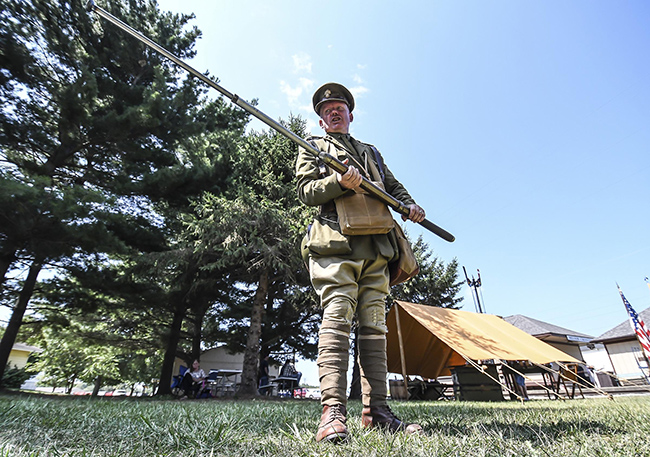
CLAY JACKSON, HERALD & REVIEW
Great War Living History Enthusiast Ian Houghton talks about Britain’s involvement in World War I during the World War I Encampment at Monticello Railway Museum on Aug. 19, 2017. The event, sponsored by the Monticello Railway Museum and the Illinois State Military Museum, signified the departure of Illinois Army National Guard troops to Camp Logan, Texas, for mobilization training from September to October 1917.

•November 7, 2018•

By Tony Reid
Of the Herald & Review

Artie Bennett, a Marine from Clinton, was cut down by a hail of bullets 100 years ago in a far-flung foreign field, giving his life for his country in America’s first global war.
A letter home from a fellow soldier said Bennett, 18, had been attacking a machine gun nest as the Marines fought, successfully, to stem a German advance threatening the French capital of Paris in June 1918, the last summer of World War I.
The fallen Marine had lingered for an hour before dying, one of the first casualties from Illinois. The letter honoring him, typed by fellow Marine Pvt. John W. Olsen, read: “He passed away quietly, without a complaint, and was laid to rest near where he fell.”
Immaculately tended American cemeteries in France, and faded memorials at home, are among the few tangible reminders of the “Great War” that began on July 28, 1914, and ended, after 18 million soldiers and civilians had died on all sides, with an armistice that went into effect at 11 a.m. on Nov. 11, 1918. Read More

Posted in Editorials

Understanding Illinois: Who is calling the signals? And Why?

News Progress Posted on November 7, 2018 by webmasterNovember 7, 2018

•November 7, 2018•

By Jim Nowlan
NP Guest Columnist

Whenever I go to a high school or college football game, I cringe at the sight of players on the field, standing as if witless (which they aren’t), looking to the sidelines for instructions from the coaches as to plays to call and defenses to mount.
I fear that technology, coaches and parents have connived, unwittingly I’m sure, to take the game away from the kids. Let’s give it back to them.
When I played high school football 60 years ago, we called our own plays in the huddle. And it was a good learning experience. In addition to using our own wits, we learned how to work together and make our own way on the field.
Quarterback Dan Carrington was the final word on play calling, yet players often chimed in with such as: “Go off left tackle, Dan. I know I can handle this guy.”
Then we went off tackle, and “this guy” reared up, pushed our left tackle aside, and smote down our halfback for a loss. Thus, Dan learned how to measure his teammates and whom he could trust. Dan later became president of Western Union.
According to coaches and veteran football officials I talked with, those days are long gone. Read More

Posted in Editorials

Understanding Illinois: Illinois: From Leader to Laggard, and Back Again?

News Progress Posted on October 31, 2018 by webmasterOctober 31, 2018

•October 31, 2018•

By Jim Nowlan
NP Guest Columnist

This is the seventh and final column on “What the next Illinois governor and legislature must do.”
In an old cartoon, Pogo surveyed the world around him and declared: We have discovered the enemy—and it is us! So it may be in Illinois. We are so glum about our fiscal, tax, political and corruption problems that many of my friends have given up on Illinois. And their dour attitude is infectious.
We all need a strong dose of Norman Vincent Peale’s power of positive thinking, which can also be infectious.
First, we are not alone in our travails. Many states face big problems. Coastal states are being hammered by more frequent and more ferocious storms. Texas and the Southwest are ever more beastly hot and desperately parched, wondering where their next drop will come from. California has not only punishing taxes but also housing prices that are pushing many out of that state.
Yet some states with big problems thrive. Minnesota has an individual income tax top marginal rate that is twice that of our tax: 9.85 percent versus our 4.95 rate. And winters that can be brutal. Yet Minnesota has a healthy, growing economy and increasing population.
For most of our state’s history, our great strengths—location in the middle of the country, dense networks of interstate highways and railroads, the nation’s leading airport for domestic and international connections, an incredibly vibrant central-city Chicago, copious surface and underground water supplies, and much higher than typical percentages of population with bachelor’s and advanced degrees—have made Illinois a leader among the states in innovation and wealth. Read More

Posted in Editorials

Chicago is Known for Capone, but Illinois Gangsters had Much Wider Reach

News Progress Posted on October 31, 2018 by webmasterOctober 31, 2018

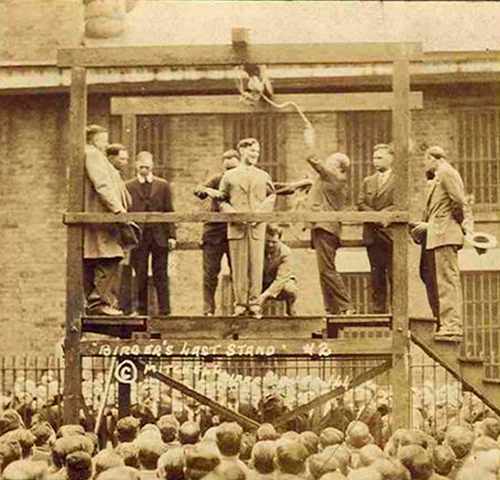
Courtesy of the Franklin County Historic Preservation Society
This 1928 photo shows bootlegging gangster Charlie Birger, center, on the gallows just before his public hanging in Benton.

•October 31, 2018•

By Barbara Vitello
Of the Daily Herald

When it came to organized crime in Illinois, Chicago-based Prohibition-era gangsters loomed large during the 1920s and 1930s.
Al Capone, Frank Nitti, Lester “Baby Face Nelson” Gillis, Jack “Machine Gun” McGurn and George “Bugs” Moran earned international infamy that persisted for decades after their deaths. For years, the general perception was that when world travelers informed locals they hailed from Chicago, the locals responded with “bang, bang” and a finger-gun gesture.
The combination of enterprising criminals, complicit public officials and Prohibition gave rise to crime syndicates involved in bootlegging, gambling, prostitution, extortion and murder. Organized by ethnicity and geography, the syndicates were known as the Chicago Mob or the Outfit. They produced the likes of Capone, Nelson and Moran — Capone’s rival and the target of an attempted assassination in 1929 known as the St. Valentine’s Day Massacre, which claimed the lives of seven men, including Moran associates and an innocent bystander or two. Read More

Posted in Editorials

Understanding Illinois: Wake Up Illinois Downstate Matters Too

News Progress Posted on October 24, 2018 by webmasterOctober 24, 2018

•October 24, 2018•

By Jim Nowlan
NP Guest Columnist

Much of Downstate Illinois (the vast 94-county region outside the 8 metro-Chicago counties) appears to be dying.
Recently at mid-day, I went out onto the three-block main street of my county-seat town—and there wasn’t a solitary auto on the streets of my once-lively little burg!
Mid-size cities like Peoria and Decatur have also been hurt, by the flight of flagship corporate offices to Chicagoland. Several downstate public universities have seen enrollments implode, their host communities twisting in the wind.
The population loss that Illinois suffered in recent years is almost wholly from Downstate.
Our state is one of interdependent regions. The suburbs wouldn’t exist were it not for Chicago. And Chicago wouldn’t exist absent the 19th Century synergies with Downstate (and the Midwest), which sent its corn and hogs to Chicago, and then to the East.
Today, however, metropolitan Chicago has to prop up Downstate schools, universities, parks and social services. Chicagoland sends much more in taxes to Springfield than it gets back in services. Downstate takes the rest.
We’re better than that, Downstate. We don’t want to be a drag on Illinois.
But where and how to start, if we want over time to rebuild our region? Read More

Posted in Editorials

Saukenuk was Once Home to Black Hawk and More Than 6,000 Sauk

News Progress Posted on October 24, 2018 by webmasterOctober 24, 2018

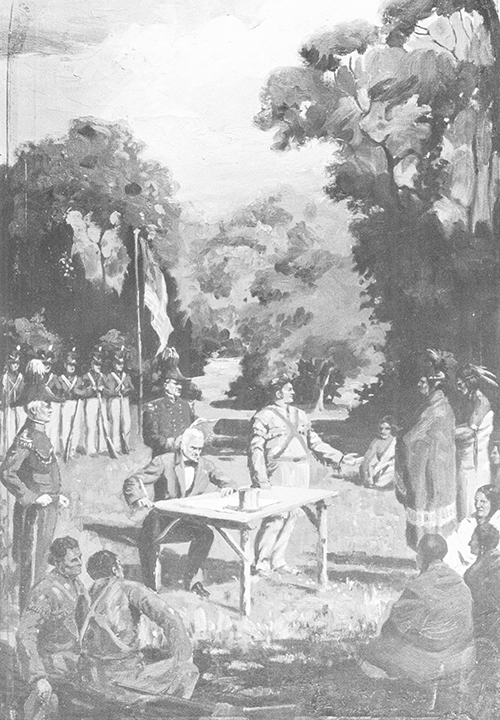
Photo courtesy of Rock Island Arsenal Museum
Antoine LeClaire, an early area settler, Illinois Gov. John Reynolds and Gen. Winfield Scott, at the table, are depicted in this mural of the signing of Black Hawk Purchase Treaty of 1832. Agreed to in the wake of the Black Hawk War, the sale conveyed Sauk lands in Iowa to the United States.

•October 24, 2018•

By Roger Ruthhart
IP Guest Columnist

Saukenuk was well-known as one of the largest Native American villages in North America, but one of its residents, the warrior Black Hawk, was even better known.
Although born in Saukenuk, which was located where Rock Island stands today, his father Pyesa and mother Summer Rain and other relatives could trace their ancestry back thousands of years. According to their oral traditions, both the Sauk and Meskwaki tribes were living in Canada 12,000 years ago at the time of the last glacial retreat. Many centuries later they were displaced from their Canadian home by the Iroquois.
The Sauk and Meskwaki migrated through New England and New York to the area near Niagara Falls. By 1640, the Meskwaki had settled at the west end of Lake Erie, near present-day Detroit, and the Sauk near Saginaw Bay in Michigan.
In 1701, the decades-long war began between the French and the Meskwaki, which almost led to the tribe’s extinction. Weakened, they joined the Sauk and together they migrated to the Mississippi River, where for nearly 100 years the tribes lived in their own villages and farmed, hunted and traded. Read More

Posted in Editorials

Bloomington’s David Davis Mansion Home to Abraham Lincoln’s Strongest Advocate

News Progress Posted on October 17, 2018 by webmasterOctober 17, 2018

PANTAGRAPH FILE
The David Davis State Historic Site at 1000 E. Monroe Drive, Bloomington.

•October 17, 2018•

By Julia Evelsizer
Of the (Bloomington) Pantagraph

Grand manors make up the skylines of many Illinois communities, but the history encapsulated at the David Davis Mansion in Bloomington holds it above the rest.
Built in 1872 on Bloomington’s then east side, the mansion was home to Judge David Davis and his wife, Sarah.
Davis served as judge of the state’s Eighth Judicial Circuit Court where he met and befriended an Illinois attorney by the name of Abraham Lincoln.
“Davis and Lincoln rode the entire circuit together,” said Jeff Saulsbery, site manager for the mansion. “Davis had to ride the circuit because he was a judge, but Lincoln only did because he was driven to make something of himself.”
Saulsbery said the duo spent plenty of time together, which led to Davis acting as “one of the biggest political operatives” in Lincoln becoming president.
“What Lincoln did for the Circuit and what the Circuit did for him is a large part of Illinois history. His time in Central Illinois is what led to him becoming the 16th president of the U.S. and saving the Union,” said Guy Fraker, retired Bloomington attorney and Lincoln scholar. Read More

Posted in Editorials

Post navigation

← Older posts
Newer posts →


Dawkins NEHS submission wows 


News Progress


Mae Dawkins, a Sullivan High School senior and member of the National English Honor Society, was recently informed that she is a national winner of the NEHS Intellectual Freedom Challenge, a prestigious competition that encourages NEHS members to craft compelling arguments defending texts that have faced challenges and bans. Her essay scored among some of the best submissions in the nation by university professors. May was awarded a certificate and a $150 dollar prize.


© 2024 - News Progress
Privacy Policy and Terms of Use

100 W. Monroe St., Sullivan, IL 61951 Phone: 217-728-7381 | Open: Hours Vary

↑